The right inverter depends on more than the panel wattage: your utility connection, sanctioned load, roof layout, export limit, operating temperature and backup expectations all affect the choice. By the end, you will be able to compare inverter types, calculate a defensible DC-to-AC design, verify electrical and grid requirements, and request the documents needed for procurement.
Key takeaways
- Choose grid-tie, hybrid or battery architecture based on outage requirements.
- Size inverter capacity against panel DC capacity, site load and JVVNL approval.
- Verify phase, MPPT count, string voltage and rooftop temperature limits.
- Request protection data, Indian compliance documents and a complete system checklist.
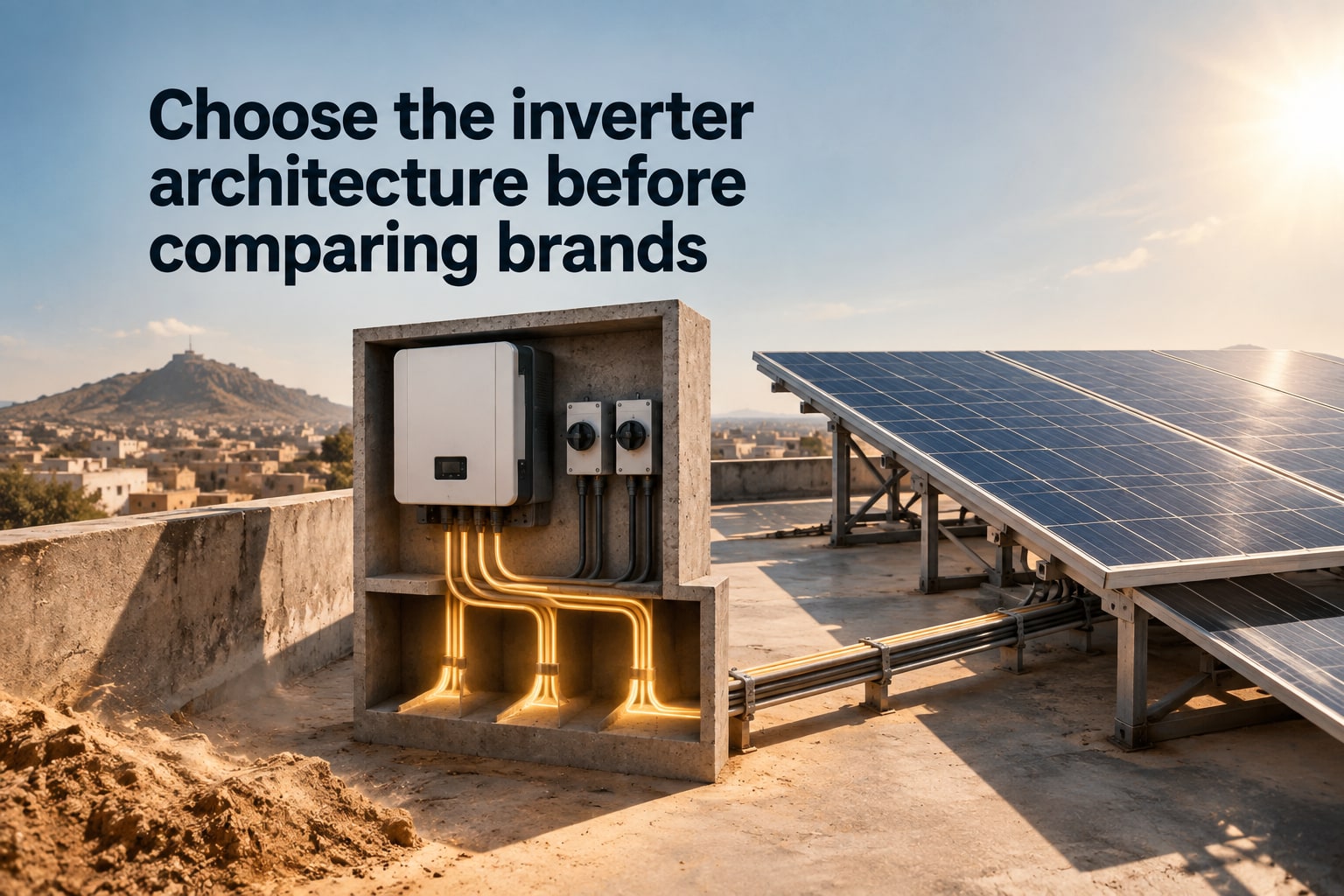
Choose the inverter architecture before you compare brands
A grid-tied inverter is not a backup source: when JVVNL supply fails, anti-islanding protection disconnects the PV system. If outages matter, choose a hybrid or battery-inverter architecture with changeover and isolation equipment.
| Option | Power and backup behaviour | Choose it when |
|---|---|---|
| String grid-tie | Converts the whole array for daytime export; no outage operation | The roof has consistent orientation and backup is unnecessary |
| Hybrid inverter | Manages PV, batteries, loads and grid; backup depends on battery size and approved wiring | You need selected-load backup and want future storage |
| Microinverter | Converts each module independently; standard units still shut down during outages | The roof has shade, multiple orientations or difficult string layouts |
Select the architecture against the expected peak load, not only panel capacity. A hybrid system must support the backed-up circuits’ starting currents and battery discharge rate; a grid-tie system only needs an AC rating compatible with the approved export capacity. Confirm the meter and sanctioned-load documents before choosing single-phase or three-phase equipment.
- Ask the solar power system supplier to verify JVVNL’s current interconnection procedure, sanctioned-load condition, metering arrangement and export limit.
- Require an approved backup diagram showing the essential-load panel, changeover, isolation and battery protections.
- Check long AC cable runs for voltage rise; undersized conductors can trigger over-voltage trips even when the inverter is healthy.
Size the inverter against panels, load and JVVNL approval
Start with the approved AC export capacity, not the roof area. For a Sikar commercial rooftop, select an inverter whose rated AC output fits the three-phase service, sanctioned load, transformer capacity and JVVNL-approved export limit. The interconnection application goes through JVVNL, so confirm its current metering arrangement, export-control conditions and protection requirements before ordering.
Size the array and inverter in this order:
- Obtain the latest sanctioned-load document, electricity bill, meter phase and proposed JVVNL interconnection capacity.
- Set inverter AC output at or below the approved export capacity unless the utility approves a documented export-limiting scheme.
- Add DC module capacity above inverter AC capacity only after checking the manufacturer’s permitted DC oversizing. A DC-to-AC ratio around 1.1 to 1.3 is a design starting point, not a universal approval limit.
- Calculate clipping from the extra DC capacity and state it in the yield estimate; do not hide it inside a larger headline kWp figure.
- Check the module’s cold-weather open-circuit voltage against the inverter’s maximum DC voltage and its hot-weather operating voltage against the MPPT range.
- Recheck string current, MPPT current, voltage rise and future expansion before fixing the inverter model.
A larger panel field cannot compensate for an undersized approved AC connection. Use solar equipment supply for rooftop projects in Sikar that includes the module, inverter, DC protection and export-control design, rather than buying each item on its lowest unit price.
A grid-tied inverter also disconnects during a utility outage; backup operation requires separate battery equipment and isolation.
Match phase, MPPT inputs and string voltage to the roof
A three-phase connection needs a three-phase inverter; a single-phase roof needs a single-phase model unless the approved design permits otherwise. Confirm this from the utility meter, sanctioned-load document and point-of-connection drawing, not from the number of panels. An inverter with the wrong phase arrangement can fail approval or unbalance the building supply.
MPPT inputs must match the roof’s electrical zones. Put strings with similar orientation and shading behaviour on the same MPPT, while using separate inputs for different roof faces or shaded sections. A string inverter with several independent MPPTs suits a divided roof better than one shared tracker; a uniform array can use fewer inputs.
Check the module datasheet against the inverter’s full DC window. Calculate each string’s cold-weather open-circuit voltage and confirm it stays below the inverter’s maximum DC voltage. Then check the hot-weather maximum-power voltage remains inside the MPPT operating range.
Also compare module operating current and short-circuit current with the maximum current allowed on each MPPT; high-current modules can clip even when voltage looks correct.
Ask the solar inverter supplier to document:
- MPPT count, voltage range, startup voltage and maximum DC voltage
- Maximum operating current and short-circuit-current limit per MPPT
- String count, connector type, DC protection and earthing arrangement
- AC voltage range, power-factor capability and communications protocol
- AC cable size and voltage rise to the point of common coupling
Long cable runs or a weak feeder can trigger over-voltage trips, so review that connection alongside the approved export limit.
Check heat, dust, grid protection and Indian compliance
A Sikar rooftop inverter needs an ambient-temperature rating and derating curve suited to intense summer heat, plus an outdoor enclosure rated for dust and rain.
Check its maximum DC voltage against the modules’ cold-weather open-circuit voltage and its MPPT range against hot-weather operating voltage; a string that passes nominal calculations can still damage the inverter or stop tracking.
| Check | Specification or evidence | Failure prevented |
|---|---|---|
| Heat and dust | Datasheet ambient range, high-temperature derating curve, and IP65 or IP66 enclosure | Output loss, dust ingress and overheating |
| Grid protection | Anti-islanding, over/under-voltage, over/under-frequency, DC injection limits and automatic reconnection settings | Unsafe energising during an outage or abnormal grid |
| Indian compliance | Test certificates or declarations referencing IS 16221 Part 1, IS 16221 Part 2 and IS 16169 | Rejection of equipment that carries only a CE mark |
Anti-islanding is not the same as an AC isolator. Commissioning must verify AC/DC isolation, polarity, earthing, insulation resistance, protective-device settings and reconnection after grid restoration. A grid-tied inverter cannot supply your loads during a utility failure; specify a hybrid or battery inverter with approved changeover equipment for backup.
Have the solar grid tie inverter supplier match module current, MPPT current, string count, DC protection, connectors, earthing and monitoring with the commercial solar panel supplier’s design. Before ordering, confirm JVVNL’s current interconnection, sanctioned-load, metering and protection requirements for the site.
Build a procurement checklist for the complete rooftop system
A low module price is not a low project cost if the inverter clips output, connectors do not mate, or warranty responsibility is disputed. Compare the complete electrical design, not separate quotations.
| Comparison point | Strong supplier evidence | Warning sign |
|---|---|---|
| Modules and inverter | Module Imp, Isc, inverter MPPT current, string count and DC-to-AC ratio shown together | Panel and inverter datasheets supplied separately |
| Protection and wiring | DC isolators, fuses, SPD, earthing, compatible connectors and cable sizes listed | “Complete BOS” without ratings or brands |
| Grid connection | AC voltage-drop calculation to the point of common coupling, export limit and export-control method stated | Inverter selected only from roof area |
| Installation | String layout, mounting drawings, cable routes, testing and commissioning included | Labour excluded from the price |
| Warranty | Serial-number process, response contact and exclusions identified for modules, inverter and workmanship | One vague warranty covering everything |
Use this document checklist before issuing a purchase order:
- Request the final single-line diagram, module datasheets, inverter datasheet and string schedule.
- Check every module connector against the inverter connector; do not approve mixed connector brands without a stated compatibility test.
- Confirm MPPT current, short-circuit-current limit, startup voltage and maximum DC voltage against each string.
- Require insulation-resistance, polarity, open-circuit-voltage, earthing and anti-islanding test records at handover.
- Put cleaning access, monitoring credentials, replacement responsibility and warranty escalation in writing.
Kusum Surya Ghar LLP can be compared with other suppliers by asking for this same combined design pack, rather than judging a commercial solar panel supplier or solar grid-tie inverter supplier on unit price alone.
Related items
Inverter Solar Grid-Tie Inverter with H6 Technology Visiontek Solar Grid-Tie Inverter with H6 Technology Product Description The Visiontek Solar Grid-Tie Inverter with H6 Technology is designed to... View service → |
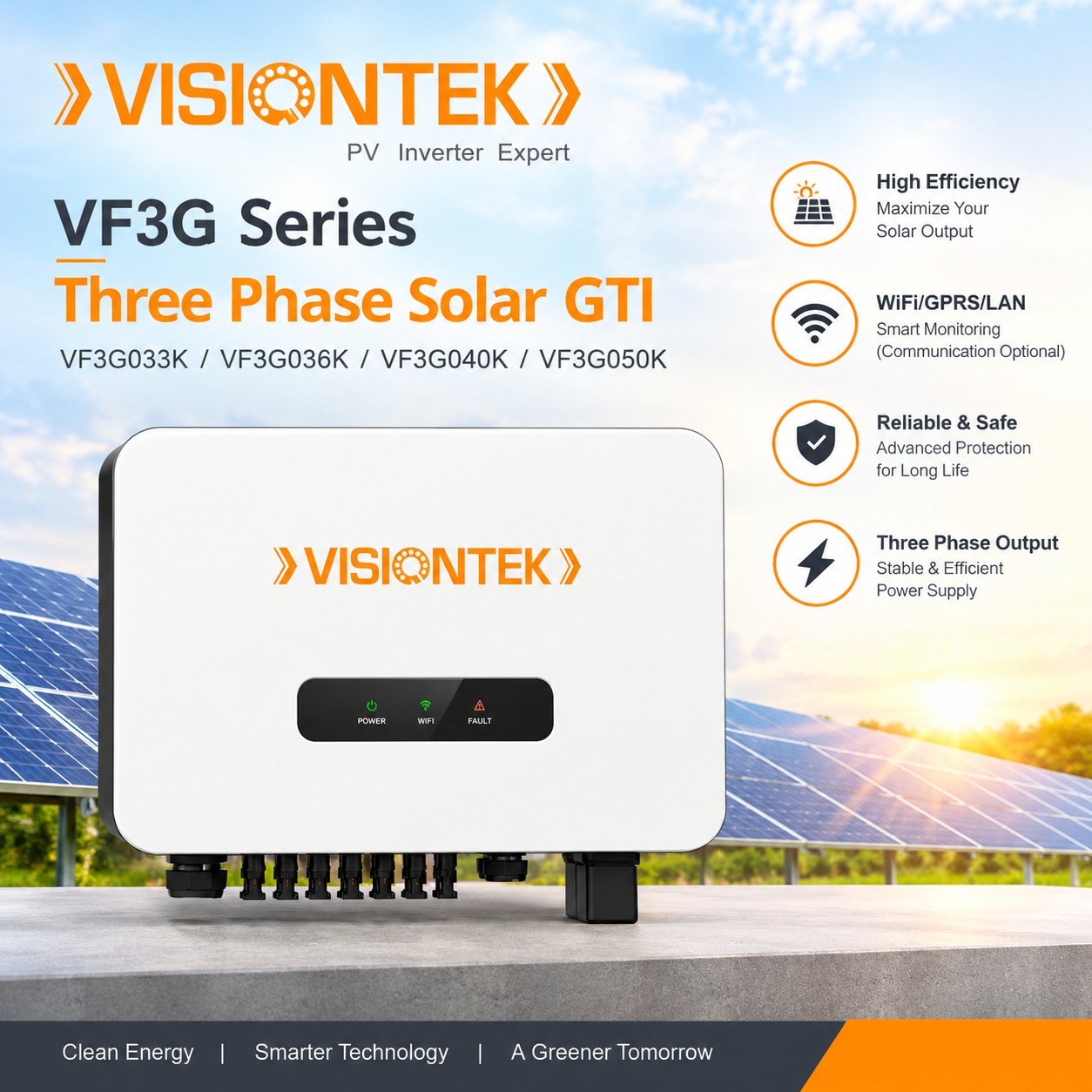 | Inverter Three Phase 50kW Solar Grid-Tied Inverter High-Efficiency Solar Power Conversion for Commercial and Industrial Applications The Three Phase 50kW Solar Grid-Tied Inverter is an advanced solar... View product → |
Frequently asked questions
Does a solar grid-tie inverter provide power during a JVVNL outage?
No. Anti-islanding protection disconnects the PV system when JVVNL supply fails. Choose a hybrid or battery-inverter system with changeover and isolation equipment for backup power.
How do you size a grid-tie inverter for a rooftop project?
Compare the panel array’s DC capacity with inverter AC capacity, the site’s daytime load and JVVNL interconnection limits before selecting the model.
Which inverter specifications must match the roof?
Match single-phase or three-phase output, MPPT input count, operating voltage range, maximum string voltage and the number of roof-facing array sections.
What should you check before buying a solar grid-tie inverter in Sikar?
Check temperature ratings, dust protection, surge and overvoltage protection, anti-islanding functions, monitoring, warranty terms and Indian compliance documents.
Keywords