Choosing a LiFePO4 battery involves more than comparing ampere-hours or panel capacity. You will be able to compare its practical benefits with lead-acid, check inverter compatibility, calculate usable storage, identify unsuitable loads and specify a safer installation for Ajmer’s hot conditions.
Key takeaways
- Compare usable kWh and depth of discharge, not amp-hours alone.
- Check inverter voltage, charging limits and communication compatibility before installation.
- Size storage from measured household loads and backup duration.
- Ask suppliers for datasheets, warranty terms, test reports and service support.
What LiFePO4 changes compared with lead-acid batteries
LiFePO4 changes the comparison from nameplate amp-hours to usable kilowatt-hours. A lithium-iron-phosphate pack usually delivers deeper discharge, less voltage sag under load and lower weight, so appliances run more consistently and the battery stores more usable energy in less space. Useful solar battery keywords include usable kWh, depth of discharge and cycle life—not Ah alone.
| Measure | LiFePO4 | Flooded lead-acid |
|---|---|---|
| Usable energy | Higher permitted discharge; compare delivered kWh | Lower usable fraction to protect service life |
| Load performance | Lower voltage sag | Greater voltage drop as load rises |
| Maintenance | No water topping-up or acid equalization | Requires electrolyte checks, water topping-up and equalization |
| Weight | Lower for equivalent usable storage | Heavier |
| Charging | Constant-current/constant-voltage profile | Different charge and equalization routine |
Plan on roughly 2,000–6,000 LiFePO4 cycles only when the specification states depth of discharge, temperature, charge rate and end-of-life capacity, such as 70% or 80%. The battery still needs correct charge limits, cut-off settings and storage state of charge; low maintenance is not maintenance-free.
LiFePO4 is more thermally stable than nickel-rich lithium chemistry, but it is not fireproof, so the BMS, fuses, enclosure and clearances still matter. Frequent cycling can justify its higher price through usable energy and fewer replacements; rarely used backup may age by calendar time before those savings appear.
How to match a Visiontek battery to your solar inverter
A 51.2 V, 100 Ah battery stores 5.12 kWh nominally, but that label does not prove it can run a large inverter. A 5 kW inverter draws about 98 A at perfect efficiency, and more after losses.
1. Match the battery’s nominal voltage with the inverter’s battery-voltage window. Then verify the battery charge-voltage range, low-voltage cut-off, continuous and peak charge and discharge current, and maximum PV charging current.
2. Select the inverter’s lithium operating mode and disable flooded-lead-acid equalization. Use equalization only when the battery manufacturer explicitly permits it; the wrong setting can overcharge a LiFePO4 pack.
3. Ask a solar inverter and battery supplier to confirm the BMS interface: CAN, RS-485 or a documented dry-contact arrangement. Check the connector pinout, communication topology, inverter firmware compatibility and the approved number of parallel batteries.
4. Confirm that the BMS supports continuous-duty operation at the inverter’s demand, not just a brief peak. Require cell protection, temperature monitoring and controlled shutdown as well as the published current ratings.
A consumer-electronics or electric-vehicle lithium battery is not automatically suitable for stationary solar use. It may lack solar charging controls, the correct profile, a suitable enclosure, inverter communications or continuous-duty ratings. Choose the exact Visiontek model only after these values match the inverter manual.
How to size usable storage for your actual household loads
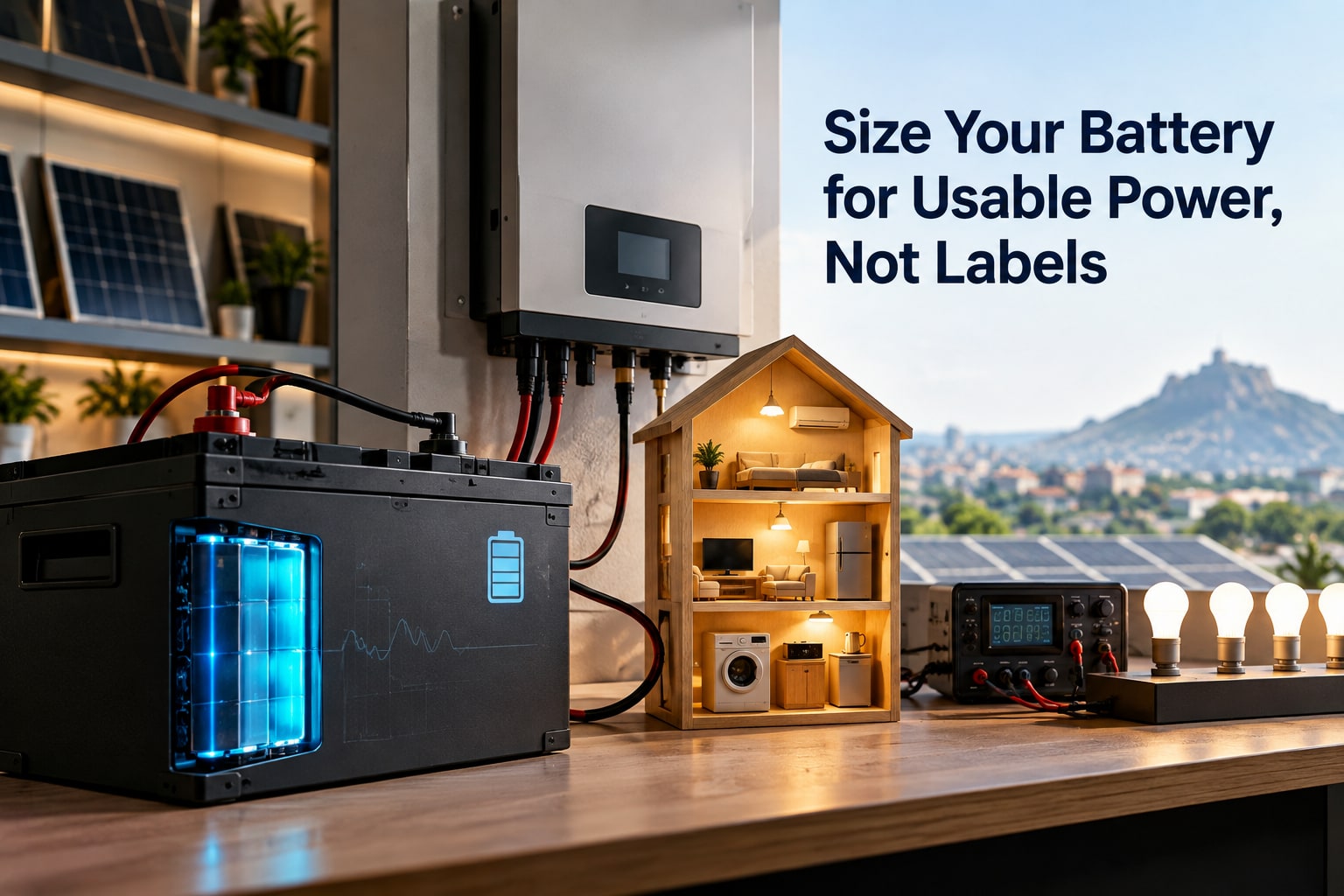
Size storage from essential-load energy and backup duration, not panel wattage alone. Required nameplate energy equals essential-load kWh divided by inverter efficiency and permitted depth of discharge.
For an eight-hour backup, this household uses:
| Load | Running load | Energy used |
|---|---|---|
| Two fans | 100 W | 0.80 kWh |
| Six LED lights | 54 W | 0.43 kWh |
| Refrigerator | 120 W equivalent | 0.96 kWh |
| Router | 10 W | 0.08 kWh |
The total is about 2.27 kWh. At 90% inverter efficiency and 80% permitted discharge, size for 2.27 ÷ 0.90 ÷ 0.80 = 3.15 kWh of nameplate storage.
A 51.2 V, 100 Ah battery stores 5.12 kWh nominally. Multiplying by an illustrative 80% usable depth of discharge gives about 4.1 kWh DC before inverter losses, or roughly 3.7 kWh AC at 90% efficiency.
Running watts are not the whole power test. The refrigerator might draw a 600 W starting surge, taking the combined momentary demand from 284 W running to about 764 W. The inverter’s continuous rating must cover the running load, and its surge rating must cover motor start.
Pumps, air conditioners, heaters, welding equipment and induction cooktops can exceed a small battery system. Check cable losses, battery temperature, inverter cut-off voltage and BMS reserve margins because delivered kWh can differ from the nameplate. The useful solar battery keywords are usable kWh and peak kW.
What the BMS protects—and what it cannot correct
The BMS is a built-in safety and control system, not an optional accessory for solar battery applications. It monitors each cell and disconnects the battery when operating limits are exceeded.
- Cell over-voltage and under-voltage protection
- Overcharge and over-discharge control
- Charge and discharge over-current protection
- Short-circuit protection
- Temperature monitoring
- Cell balancing
- Controlled contactor or MOSFET shut-down
A BMS cannot correct an incorrectly configured inverter, undersized DC cables, loose terminals, missing fuses, poor earthing, blocked ventilation or excessive ambient heat. It can disconnect a fault; it cannot make an unsafe installation safe.
Parallel banks require the manufacturer’s written limits for unit count, communication topology, cable lengths, fuse arrangement and current-sharing method. Ignoring these details can create unequal currents and premature BMS cut-off. Do not mix batteries with different ages, firmware versions, capacities or state of health.
For Ajmer installations, follow the exact model installation manual for charge and discharge temperature limits, enclosure rating, clearances and mounting instructions. Heat, dust, humidity and direct sun can reduce available power and shorten service life. Check these conditions before choosing solar battery keywords or comparing models.
What to request from a solar inverter and battery supplier in Ajmer
A battery’s model number, not the brand name, determines the real Visiontek LiFePO4 battery benefits in Ajmer. Ask a solar inverter and battery supplier for this procurement record before comparing quotations.
1. Request the exact Visiontek model, nominal voltage, nameplate and usable capacity, continuous and peak current, charge limits, operating-temperature range, ingress rating, BMS protections, CAN or RS-485 protocol, connector layout, compatible inverter and firmware list, warranty conditions, and replacement-BMS policy.
2. Require cycle-life results at a stated depth of discharge, temperature, charge/discharge C-rate, and end-of-life capacity such as 70% or 80%. Reject a headline cycle count without those conditions.
A visiontek lifepo4 battery supplier should also provide UN 38.3 transport evidence and applicable stationary-battery documentation, such as IEC 62619 or an applicable BIS-adopted standard; transport compliance alone does not prove installation safety or grid compliance.
3. Inspect the proposed site for indoor or shaded outdoor placement, ventilation, humidity and dust control, clearance, secure mounting, correctly sized DC cables, a DC isolator, fuse or breaker, earthing, and fire access. Confirm that the inverter disables flooded-lead-acid equalization unless the battery maker permits it.
4. Before acceptance, have the solar inverter and battery supplier test the complete battery-inverter system, not just deliver a battery. Record DC voltage, current, delivered kWh, cut-off behaviour, and inverter fault codes. Kusum Surya Ghar LLP can add value by checking these interfaces and installation details when supplying a matched system.
Related service
Batteries VISIONTEK LiFePO4 Batteries Reliable Energy Storage for Homes and Solar Systems The VISIONTEK LiFePO4 Battery Series is designed to provide reliable energy storage for home... |
Frequently asked questions
How does a Visiontek LiFePO4 battery differ from a lead-acid battery?
LiFePO4 batteries usually offer deeper usable discharge, lower weight, less voltage sag and more consistent appliance performance than lead-acid batteries.
How do you match a Visiontek battery to a solar inverter?
Check the battery bank voltage, inverter charging and discharge limits, maximum current, communication protocol and approved battery list before connecting them.
How do you size usable battery storage for household loads?
List each appliance's wattage and runtime, add the energy in watt-hours, allow for inverter losses and reserve capacity, then convert the result to usable kilowatt-hours.
What does a battery management system protect against?
A BMS monitors cell voltage, temperature and current and can disconnect the pack during unsafe conditions. It cannot fix undersized cables, incorrect inverter settings, poor installation or an overloaded system.
What should you request from a solar battery supplier in Ajmer?
Request the battery datasheet, nominal and usable capacity, voltage range, maximum charge and discharge current, warranty, installation guidance, communication details and local after-sales support.
Keywords